
Outlook
Small business CRM in Scotland: choosing a support route
Small business CRM support in Scotland: how to choose between Business Gateway, Scottish Enterprise and Find Business Support, and how to write the case.
What to take away
- A small business CRM project in Scotland can be grant funded through Scottish Enterprise or advised through Business Gateway, but the two routes work differently.
- Scottish Enterprise tends to back larger, growth focused projects, while Business Gateway covers start ups and smaller firms with free advice and local workshops.
- You will need a written funding case, a cost breakdown and a plan for training before an adviser will back a CRM purchase.
- Post project reporting matterskeep invoices, attendance records and adoption metrics for the agreed monitoring period.
- Most CRM projects stall on data quality, staff habits or unclear ownership, not on the software itself.
How Scottish Enterprise and Business Gateway fit into CRM adoption
Scotland's business support system is not one door. It is two, plus the Scottish Government above them. Scottish Enterprise is the national economic development agency. It works with companies that have growth potential, usually with a trading history and staff numbers that justify a bigger project.
Business Gateway is the local access point. The Scottish Government gives local authorities the resources to deliver Business Gateway, and the service covers everything from a first enquiry to a funded review. The Scottish Government also supports businesses through its enterprise bodies, including Scottish Enterprise and Highlands and Islands Enterprise.
For a small business CRM project, the practical question is which door you knock on first. A one person consultancy buying a contact system will not get a Scottish Enterprise account manager. A ten person engineering firm with a sales pipeline problem might. Both can get advice. Only one is likely to get a grant.
The UK Government publishes its own business policy behind support programmes, but business support in Scotland is devolved. Scottish Enterprise and Business Gateway decide what is eligible and what is not.
This matters because CRM is rarely funded as software on its own. It is funded as part of a growth plan: more leads handled, fewer lost enquiries, better reporting to a bank or an investor. Frame it that way and you fit the system. Frame it as a licence purchase and you will be sent to a comparison site.
What grant and advice support Scottish SMEs can actually ask for
Start with advice, because it is free and it shapes everything else. Business Gateway offers one to one adviser sessions, webinars and local workshops. A typical CRM conversation there covers what you actually need, what it costs and whether your data is in a fit state to migrate.
Scottish Enterprise support is more selective. It can include account management for growth companies, innovation support, and grant funding towards projects that create jobs or increase turnover. CRM often appears as a component of a larger project rather than the headline.
Loans can also sit behind a digital project. Inspirent (formerly Lanarkshire Enterprise Services Ltd) has delivered the Digital Development Loan for the Scottish Government, and an impact appraisal of the loan found that businesses heard about it mainly through Business Gateway and the enterprise agencies. The same Digital Development Loan impact appraisal reports that loan amounts ranged from £5,220 to £100,000, with a median advance of £50,000. Ask your adviser whether it, or a successor scheme, is open when you apply.
What you can realistically ask for:
Support Scottish SMEs can ask for
- A funded business review that includes a CRM needs assessment.
- A grant contribution towards implementation costs, not just licences.
- Support for training and staff time during rollout.
- Help with data cleaning and migration as part of a wider digital project.
- Introductions to approved suppliers and, in some cases, procurement help.
What you are unlikely to get:
- Funding for a licence you would have bought anyway with no change in how you sell.
- Retrospective funding for a system already live.
- A grant that covers 100 per cent of the cost.
Grant rates and caps change, so treat any figure you read as a starting point for a conversation, not a promise. The Scottish Government provides information on all funding available to Scottish businesses on Find Business Support, so check the current schemes there before you contact a Scottish adviser.
Councils run their own grant schemes too, usually through Business Gateway. North Lanarkshire Council's Business Growth Fund for local SMEs prioritises projects that boost turnover, create jobs, enhance productivity, promote environmental sustainability and advance digital capabilities. Eligible projects are 50% grant-funded, with up to £20,000 per application and a maximum of £40,000 over a 24-month period; workforce or skills development is capped at £5,000. Applicants must be actively working with a Business Gateway adviser, and the grant is paid retrospectively, so you pay the supplier first and reclaim the grant afterwards. Other councils set their own rates, so read the scheme for your area before you write the case.
Matching a small business CRM project to a funding route
Not every CRM project belongs in a grant application. Matching the project to the route saves months.
Use this as a rough sorting exercise:
Matching a CRM project to a route
Likely route
- Sole trader, first CRM
- Business Gateway advice
- Under 10 staff, replacing spreadsheets
- Business Gateway plus local grant schemes
- 10 to 50 staff, sales pipeline problem
- Scottish Enterprise or Business Gateway
- Exporting or scaling fast
- Scottish Enterprise
- Part of a sector cluster
- Both, plus sector bodies
What to expect
- Sole trader, first CRM
- Free sessions, no grant
- Under 10 staff, replacing spreadsheets
- Advice, small capital grants in some areas
- 10 to 50 staff, sales pipeline problem
- Account management or project grant
- Exporting or scaling fast
- Larger project funding, conditions attached
- Part of a sector cluster
- Introductions, shared training
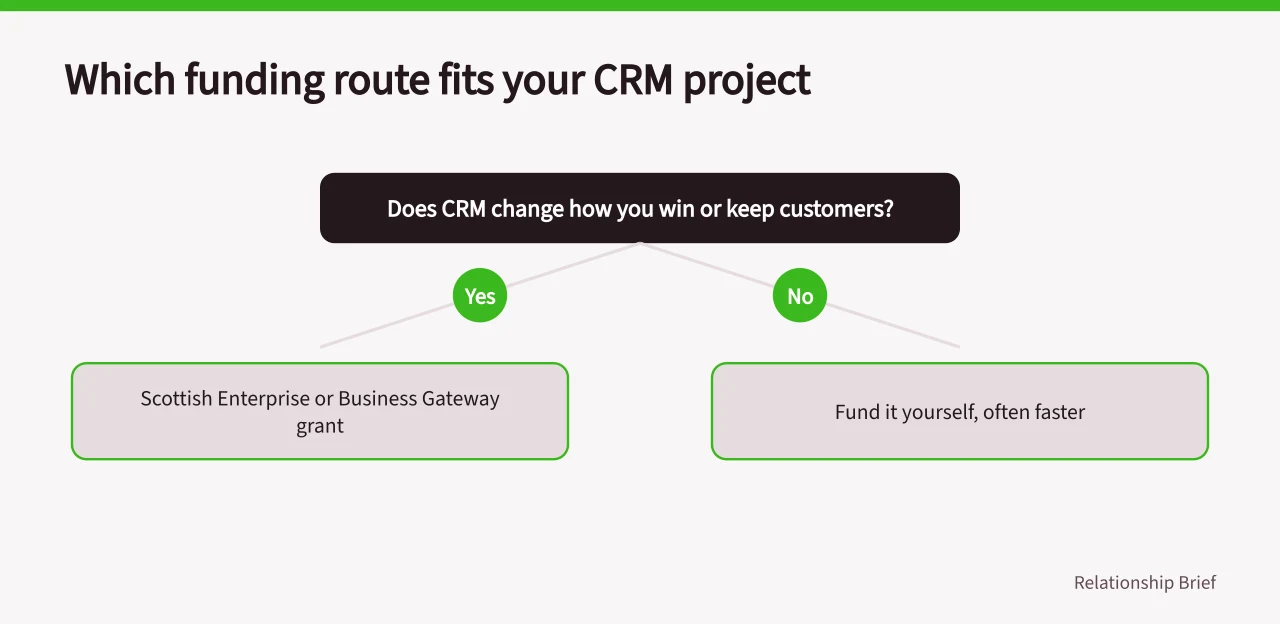
Two practical tests decide most cases. First, does the CRM change how you win or keep customers? Second, can you describe the change in numbers you already track, such as quote to order time or enquiries answered per week? If the answer to both is yes, you have a fundable project.
If the answer is no, you still have a project worth doing, but fund it yourself. That is often faster. A controlled rollout over ninety days to a controlled decision is a sensible model to borrow, even though the funding rules differ north of the border.
Building the CRM case a Scottish adviser will read
Advisers read dozens of these. The ones that get funded share a shape: a problem, a plan, a cost, and a way to check it worked.
Write it in this order.
- State the problem in operational terms. Lost enquiries, duplicate records, no view of the pipeline, hours spent rebuilding spreadsheets.
- Describe the change you want. One shared contact record, a visible pipeline, automatic follow up tasks, simple reports.
- Set out the options you considered, such as two or three named CRM products (HubSpot, Zoho CRM or Pipedrive, for example) at the edition you would buy. Include doing nothing and a cheaper tool. Advisers distrust a single quote with no comparison.
- Give costs with dated quotes, full labour and a separate line for internal time.
- Show the benefit in numbers you already collect, with a realistic time frame.
- Name the person who owns the project and the people who will use the system daily.
- Add a short risk sectiondata protection, migration failure, staff resistance, supplier dependency.
The funding case document is where most applications are won or lost. Keep it to a few pages with an appendix of quotes. Do not pad it with software feature lists. An adviser can tell the difference between a genuine operational problem and a wish list.
One more point on data. Under UK GDPR, which the Information Commissioner's Office (ICO) regulates, you need a lawful basis for the personal data in your CRM, a retention rule and a way to handle subject access requests. Say how the new system supports that. It is a small section that signals you have thought about the boring parts.
Adoption, training and the Scottish support network
Buying the software is the easy part. Adoption is where the money is made or lost. Plan training before you sign, not after.
CRM adoption sequence for Scottish SMEs
- Clean data you intend to migrate
- Configure only first-month essentials
- Train daily users first
- Run old and new for two weeks
- Train wider team once basics work
- Review usage at 30 and 90 days
Business Gateway workshops and Scottish Enterprise funded training can cover part of this. Local colleges and sector bodies also run short courses. The Scottish Government funds Skills Development Scotland, whose free Skills for Growth diagnostic tool helps a business understand its training needs before a rollout. The point is to budget for time, not just licences. A CRM that nobody logs into is an expensive address book.
Be honest about skills. A task based view of what your team will actually do each week is more useful than a job title. A forecast that invents no vacancies or salaries is the right approach: list the tasks, estimate the hours, then decide whether to train, hire or simplify the system.
Where CRM adoption stalls and how support helps
Most stalled CRM projects in Scottish SMEs fail for the same handful of reasons.
Where CRM adoption stalls
- No named owner after go live.
- Data migrated without cleaning, so nobody trusts it.
- Too many fields and stages configured at the start.
- No link between CRM use and how people are managed.
- Training delivered once, then forgotten.
Support helps because it adds an outside deadline and an outside pair of eyes. A grant agreement with a completion date and a reporting requirement does more for momentum than any internal memo. An adviser will also push back on an oversized scope, which is the most common cause of a slow death.
The ONS statistics on the UK business population, including small businesses in Scotland show how crowded the small business base is. Most of your competitors are small firms with the same CRM habits you have. That is a reason to keep the project simple and finish it.
Records, evidence and reporting after a funded CRM project
If you take public money, you accept conditions. Reporting is part of the deal, not an afterthought.
Funded CRM project file checklist
- Signed funding case and variation letters
- Supplier quotes, contracts and invoices
- Proof of payment from your bank
- Training attendance records and materials
- Adoption log with 30 and 90 day usage
- Scope change notes and approvals
- Evidence of promised outcome
Post project reporting usually asks for the same things: what was spent, what was delivered, what changed. Answer in the format the funder gave you, with the numbers you already agreed. Late or vague reporting is the fastest way to sour a relationship you may need again.
Do not treat the final report as the end. If the CRM worked, say so, with evidence, and ask what the next stage of support looks like. Scottish Enterprise and Business Gateway both track outcomes, and a business that reports well tends to get a better hearing the second time.