
Measurement
Part of Small business CRM measurement: a decision-led method
CRM metrics with explicit events, populations and decision triggers
Define CRM metrics for an England small business with explicit events, populations, calculations, periods, evidence, uncertainty and decision triggers.
What to take away
- Start every CRM metric with the decision it informs, then fix the event, eligible population, numerator, denominator and period before calculating anything.
- Report counts beside rates, keep unassigned work inside the denominator, and log missing events separately.
- Leave the threshold blank until a baseline exists, then tie the trigger to a named action and owner.
- Give each metric an owner who can change the process, and review the card whenever the workflow changes.
What a metric card records
A metric card is a one-page definition that travels with the number. Version it, date it and attach it to the report so a later reader can reproduce the figure.
Field / Entry
- Decision informed
- Whether eligible intake reaches an accountable colleague
- Events
- Intake received; acceptance recorded against a named operator
- Population
- All eligible intake items in the period
- Numerator and denominator
- Items with a recorded acceptance, over all eligible items
- Unit
- Count and percentage
- Period and timezone
- Calendar month, Europe/London
- Source systems
- CRM intake object and shared mailbox export
- Query version
- v3, frozen 2 April 2026
- Owner
- Operations lead
- Uncertainty and exclusions
- Missing events, spam rule, tests, sampling method
- Action trigger
- Left blank until a baseline is agreed
The UK Statistics Authority's standards for official statistics bind official producers rather than private firms. Their emphasis on suitable data, sound methods and prominent uncertainty still serves as voluntary discipline for a business publishing management numbers. For a longer treatment of reproducible cards, see measuring a small business CRM.
Example: one month of ownership acceptance
Illustrative figures for a four-person England team running HubSpot forms, a shared mailbox and Zoho CRM.
One month of ownership acceptance
- Count every item received from 1 to 31 March 2026 in Europe/London: 501 items.
- Remove 38 synthetic tests and 51 items matching the pre-approved spam rule, leaving 412 eligible items.
- Count items where a named operator recorded acceptance289.
- Report 27 items carrying a receipt event but no logged acceptance or rejection as missing events, kept out of the rate.
- Divide 289 by 412 for a rate of 70.1 per cent.
[figure 1] 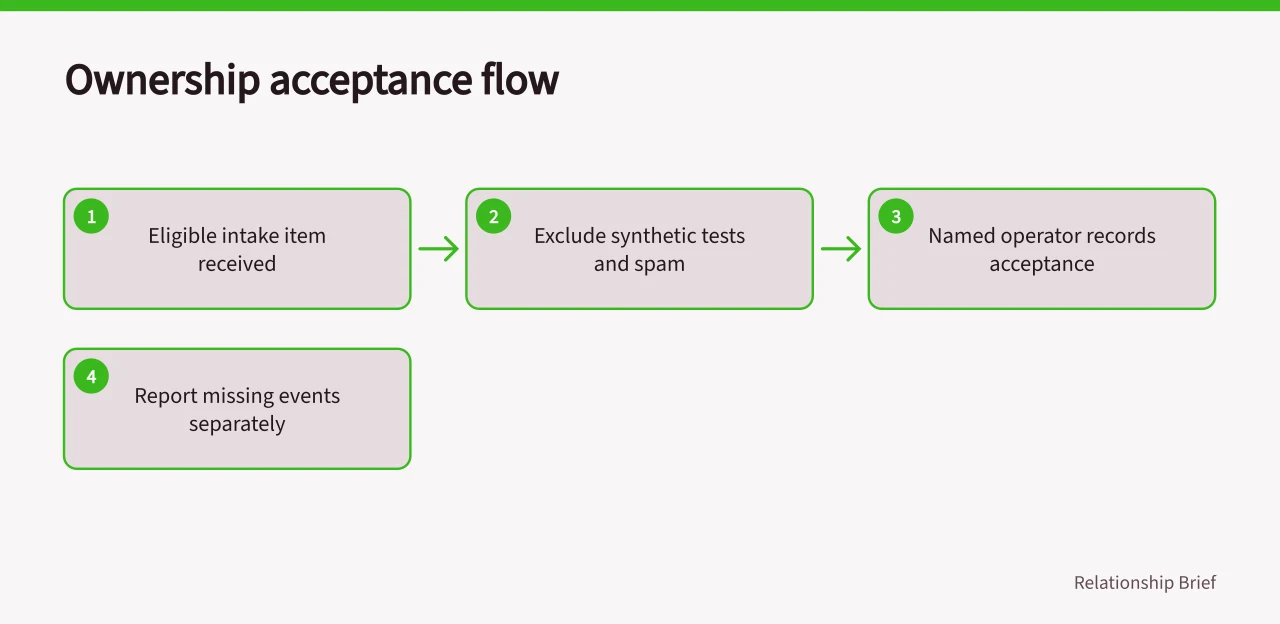
One month of ownership acceptance
- January 2026 66.4 per cent
- February 2026 68.0 per cent
- March 2026 70.1 per cent
Agreed trigger: if a monthly rate falls below 65 per cent, or sits more than five percentage points under the three-month baseline, the operations lead reviews intake routing within five working days and records the decision taken.
A baseline comes from your own records, not from someone else's average. Researching CRM benchmarks without inventing a norm explains why a published industry figure cannot stand in for your observed history.
Evidence-complete closure
The question it answers: can the business reconstruct why a record was closed? Define the population as closed items drawn from a recorded risk-based or random sample.
The numerator is the sample meeting every evidence rule, covering source, owner, outcome reason and unresolved commitment. The denominator is the full sample, including records the reviewer cannot assess.
Name the sampling frame, the reviewer and the defect definition. A convenience sample cannot support a service-wide rate. ONS guidance on uncertainty and how we measure it separates sampling error from non-sampling error. Selection bias, blank fields and processing mistakes still need disclosure here.
[figure 2] 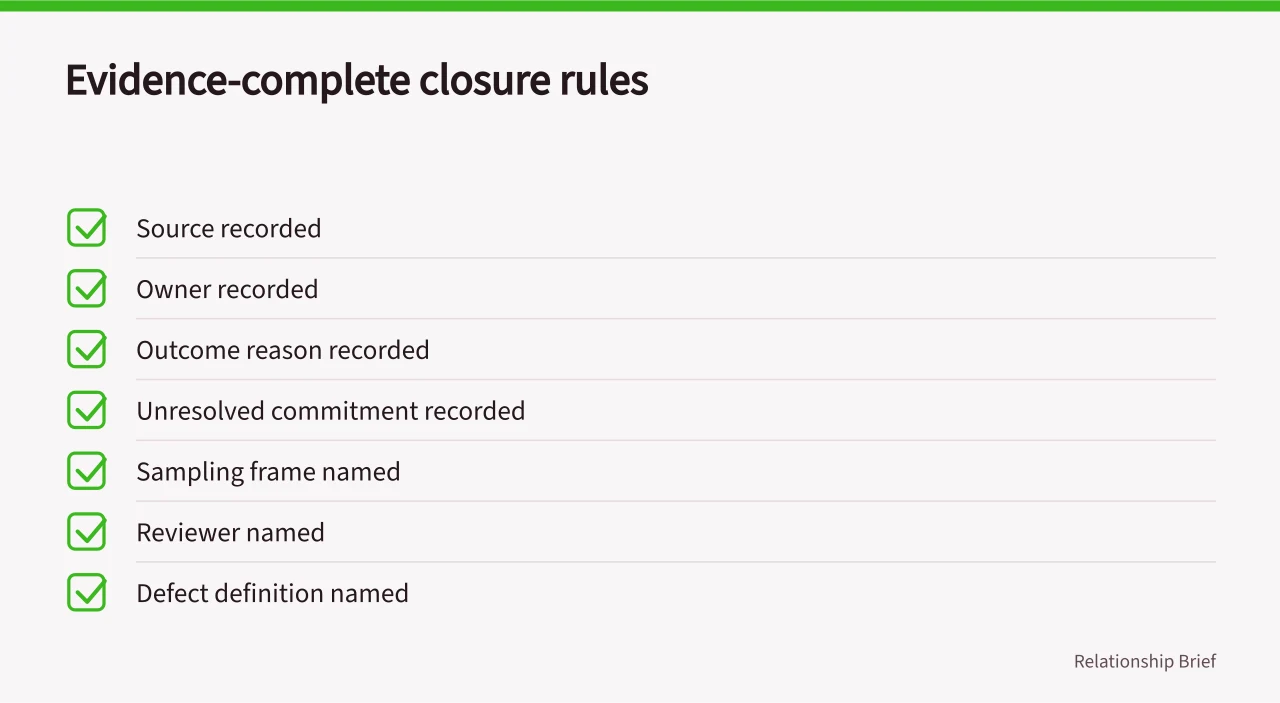
Suppression propagation across sending routes
The question it answers: did an accepted marketing objection reach every in-scope sending route? Count valid objection changes accepted in the period.
The numerator needs downstream confirmation from the CRM, the mailing platform and any scheduled campaign list. The denominator keeps every accepted change, and an unavailable integration counts as missing confirmation, not success.
This is an operational integrity measure, not proof that a message was lawful. The ICO's guide to the UK GDPR sets accuracy and storage limitation duties, which is why record hygiene belongs inside the metric. Tracking and PECR assessments stay separate.
Progression between states and recovery evidence
The question it answers: what happened to eligible work between two agreed states? Use the same cohort, eligibility rule and observation window in numerator and denominator.
Show still-open, reopened and disqualified work as separate counts. A status change is an operational event, not a conversion. CRM attribution methods set out where that distinction matters most for reporting.
For recovery, state the failure scenario, the tasks in scope and the successful end event. Report a duration alongside unresolved reconciliation defects. Contractual uptime does not substitute for an observed buyer-side exercise.
Common questions
What belongs on a CRM metric card?
The card names the decision, the two events and the eligible population. It then records the numerator, denominator, unit and period. Source system, query version, exclusions and owner sit on the same sheet, with the trigger left blank until a baseline exists.
How is ownership acceptance calculated?
Divide items with a recorded acceptance by all eligible items received in the period. Exclude synthetic tests and pre-approved spam, but keep unresolved and unassigned work in the denominator.
Does suppression propagation prove a message was lawful?
No. It counts whether an accepted objection reached each in-scope sending route. Lawful basis, tracking and PECR assessments sit outside this metric.
When should a threshold be set?
Only after you hold an observed baseline from your own records. Then agree a level, a named owner and a review window, and record the decision each time the trigger fires.